


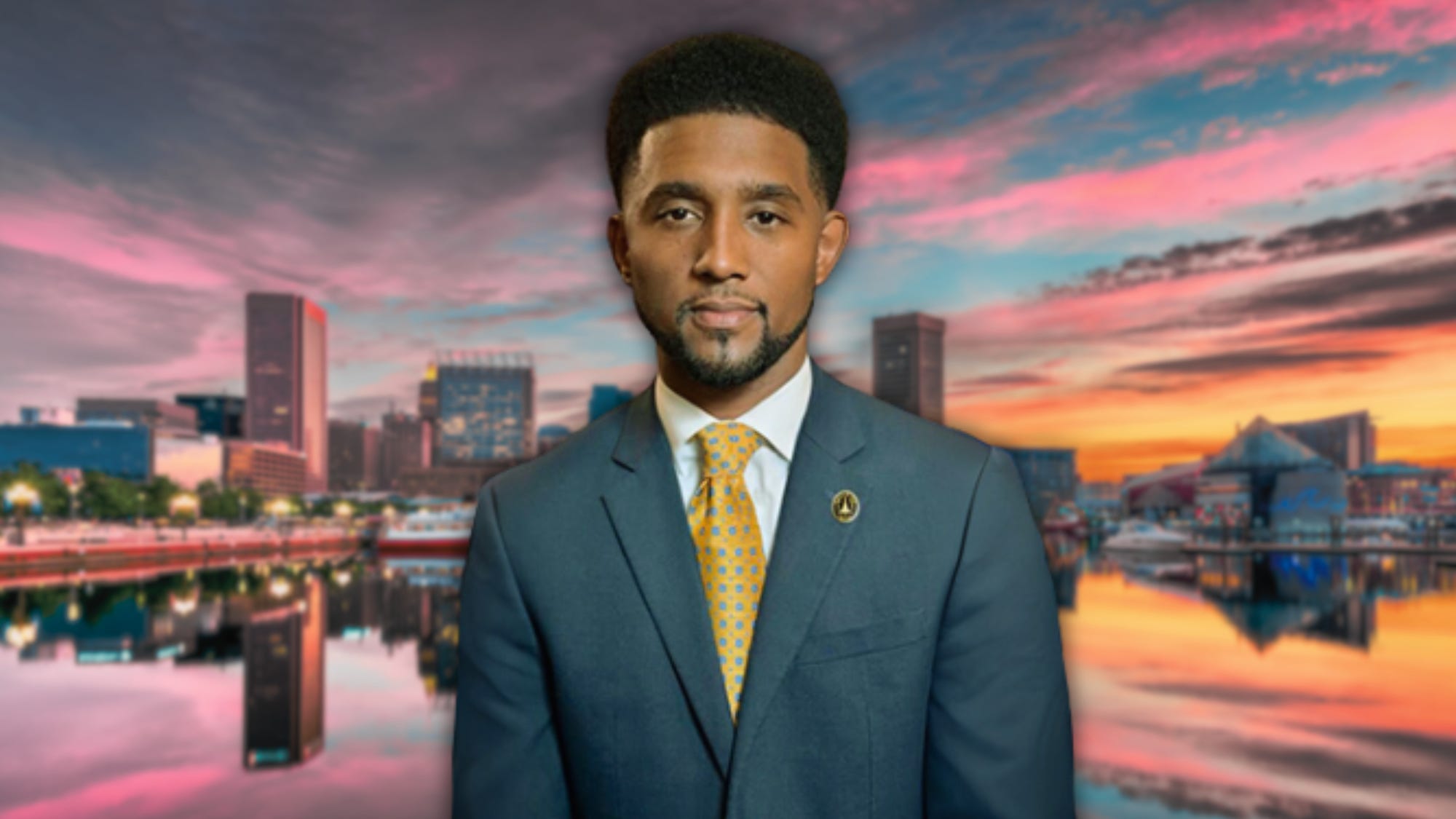
Baltimore just posted its lowest homicide total in over 50 years—and it didn’t happen by accident. This is the story of how Mayor Brandon Scott is reshaping public safety with data, community trust, and a plan that other cities should be watching.
BALTIMORE—For many Americans, this city is The Wire.
The hit HBO series, which first aired more than two decades ago, etched into the national psyche an image of Baltimore that’s gritty, chaotic, and often lawless. It told a powerful story of a post-industrial America cracking under the weight of racial inequality, police dysfunction, political malaise, and systemic poverty. It was nuanced, tragic, and brilliant, widely regarded as one of the greatest television series of all time. But it also froze the city in time. For those who’ve never been, or for those who haven’t returned, the perception stuck that Baltimore is a violent, dangerous, and broken place.
Yet that’s not the story on the ground anymore.
Today, Baltimore is in the midst of one of the most significant and underreported public safety turnarounds in the United States. In the first six months of 2025, homicides fell nearly 23%. Nonfatal shootings dropped almost 20%. Carjackings, robberies, arson, and auto thefts are all down double digits. And through the end of June, the city had recorded just 68 homicides, the fewest in more than half a century.
A Plan Rooted in Prevention, Not Punishment
The credit for this historic shift largely belongs to Mayor Brandon Scott. Since taking office in 2020, Scott has championed a radically different approach to public safety—one rooted not in mass incarceration or hyper-policing, but in prevention, accountability, and investment.
“You can’t just think you’re going to police your way out of these problems,” Scott said back in 2021. Doing things differently for him meant treating gun violence like a public health epidemic. That included identifying the people most at risk of shooting or being shot, and offering them a choice to stop the violence and receive help, or face focused law enforcement attention.
This strategy, known as Group Violence Reduction, started as a pilot in the city’s Western District. It combined targeted enforcement with social services and community support, like job training, therapy, education, relocation assistance, and credible messengers from the neighborhood who could interrupt cycles of retaliation. Within 18 months, gun violence in the Western District dropped by a staggering 33%, and the city subsequently scaled up.
Community at the Core
At the heart of Scott’s vision is the belief that public safety can’t just be reactive. That’s where MONSE—the Mayor’s Office of Neighborhood Safety and Engagement—comes in. MONSE coordinates a network of community-based violence intervention programs like Safe Streets, which employs trusted community members to mediate conflicts before they turn deadly.
This isn’t soft-on-crime idealism. It’s a data-backed strategy. A Johns Hopkins study found that Safe Streets is associated with a 23% drop in nonfatal shootings in the neighborhoods where it operates. In some of its longest-running sites, entire years have passed without a single homicide.
Baltimore has also invested in young people. The city’s Summer Youth Engagement Strategy created safe spaces and events during school breaks, including late-night basketball, open pool parties, block parties, and arts programming. The result? Youth shooting victimizations dropped by two-thirds last summer.
These programs work not because they’re flashy, but because they meet people where they are. They rebuild trust, and they give people something to live for.
Law Enforcement Still Matters, But It’s Smarter
Policing still plays a critical role in Baltimore’s public safety gains, but it looks different than it did in the zero-tolerance era. The Baltimore Police Department (BPD) under Commissioner Richard Worley has doubled down on precision and accountability.
That means:
Creating a Crime Strategies and Intelligence Division to analyze trends and respond with targeted enforcement rapidly.
Removing over 1,300 illegal firearms from city streets in the first half of 2025 alone, including more than 150 ghost guns.
Achieving a 64% homicide clearance rate, well above the department’s 10-year average.
Hiring new officers committed to reform and community policing.
And working closely with state and federal partners to prioritize the most violent offenders.
“We’ll continue to strengthen community policing efforts, build trust, and stay focused on reducing gun violence and crime in our neighborhoods,” said Worley.
This coordinated, interagency model ensures that when arrests happen, they’re deliberate and backed by strong prosecutorial alignment. Scott’s administration worked closely with the State’s Attorney’s Office, U.S. Attorney, Maryland State Police, and the Office of the Attorney General to create what’s essentially a coalition of consequence, so that the worst actors are held accountable. At the same time, low-level offenses don’t clog the system.
“We’re focusing our efforts where they’re needed most and not relying on policing alone,” Scott said. “This is about changing systems, investing in people, and making safety equitable across every neighborhood.”
It’s an approach that respects civil liberties and achieves results. And it’s helped the city begin to emerge from the shadow of a decades-long consent decree with the federal government, prompted by earlier patterns of police abuse and misconduct.
A Mayor Betting on Belonging
Brandon Scott grew up in Baltimore. He’s lived what he governs. And he hasn’t shied away from calling out the systems that broke his city. But he’s also fiercely focused on building something better.
“Our continued progress is the direct result of the comprehensive, evidence-based public safety strategy that we have implemented in partnership with residents,” he said in a recent statement. “While we acknowledge the historic lows we are experiencing, we must simultaneously acknowledge that there is much more work to do.”
There’s no victory lap here. Just a clear-eyed recognition that 68 lives lost is still 68 too many, and a renewed commitment to driving that number even lower.
For years, Baltimore was a case study in American decline, and The Wire told the story of its breaking point. Now, it's becoming a blueprint for what’s possible when policing is rethought and the right investments are made in people and place.
If you enjoyed reading this article, please consider sharing it. If you have a lead for a story, please leave a comment or message me.
Thank you for writing this! MONSE and Mayor Scott deserve all of the credit. Meanwhile, there's another institution in Baltimore moving in the wrong way: https://www.baltimoresun.com/2025/07/19/maryland-youth-deserve-investment-not-incarceration-guest-commentary/