

Emoji, Rising
The lingua franca of the global web is giving us new ways to vent—and mobilize

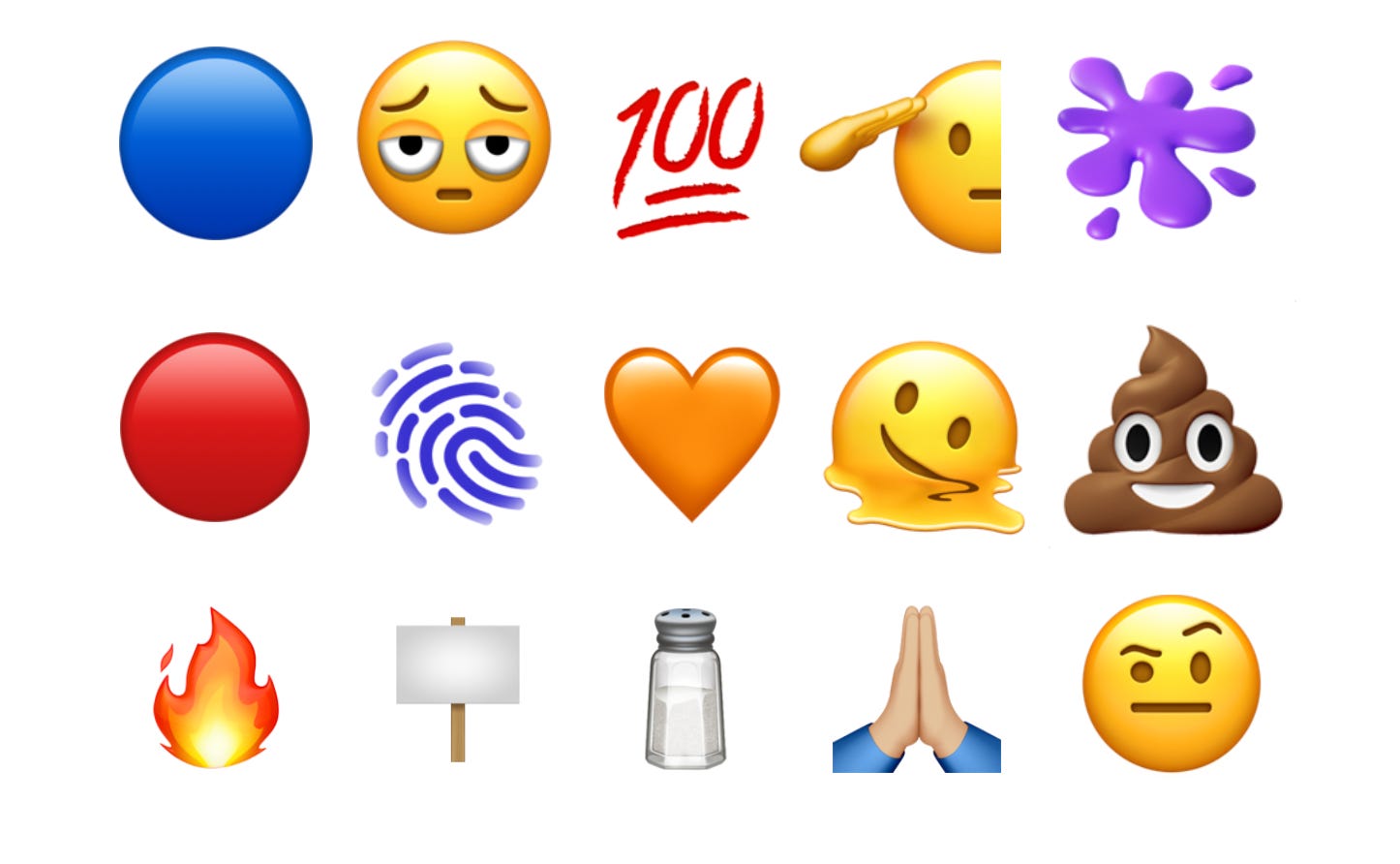
NEW YORK— Let’s all welcome .
It’s the new face-with-bags-under-eyes emoji—and one of the very latest emoticons approved to join the ranks of the 3,789 other emoji creating our world’s first universal, visual language. It’s also the most popular new emoji, according to the website Emojipedia, the world’s #1 emoji reference site.
Starting to appear on most iOS 18 smartphones, is being described by the tech industry’s emoji wranglers as “a smiley face with a strained expression and dark markings under the eyes, likely caused by stress or exhaustion.”
Sound familiar?
Struggling against today’s turbulent headwinds, “we humans are all now feeling battle weary, at least some of the time,” says journalist Chris Hayes, author of The Siren’s Call, the new best-selling book about how the digital economy, particularly social media and information overload, has transformed our attention into a commodity, impacting our minds, politics, and society. “Public discourse is now a war pitting all-against-all for attention. Commerce is now a war for attention. Social life is a war for attention, and so is parenting.”
Emoji, he says, give us the pictorial shorthand both perfect for small phone screens and short bursts of available time. is just one of a dozen new emoji designed to help people navigate change, mobilize activism—or just give us all a more satisfying (and reassuring) way to vent amid today’s turbulence. So far, it’s working.
“The rise in the number of applications for new emoji is enabling us, in a way, to track the emotional pulse of the planet.” - Author Keith Houston
Changing the Guard
Who’s managing the flood of emoji, new and old, and what’s up with this new focus on activism?
A nonprofit group called the Unicode Consortium supervises the development and distribution of emoji and is run by a rotating group of engineers, linguists and typographers charged with establishing coding consistency across the Internet’s static characters. Its goal when founded in 2010 was to enable global communication among different kinds of computers. Today, its technologists serve more like gatekeepers and digital community leaders and organizers, reviewing applications for new emoji and assessing the level of demand for new ones.
“It’s now becoming more like a body of people who are constantly taking the emotional pulse of the planet, just by the torrent and types of emoji people say are still needed,” says Keith Houston, the author of Face With Tears of Joy: A Natural History of Emoji. He says an emoji’s superpower is its fluidity. Quite often, the meaning or nuance of an emoji can be re-purposed or changed over time to reflect new trends in culture, politics, business or global events. Emoji also can have different meanings, depending on the generations using them. [I remember being told by my Gen Z students last year that the well-meaning 👍 emoji can be interpreted by those under age 25 as being passive-aggressive.]
Still not convinced of their value?
Here are a few more emoji now being used by social change organizers to mobilize activism and rally their digital crowds to showcase their solidarity in response to what’s happening in politics, government, climate change and the rest, including the Trump administration’s rapid changes made since January:
Saluting Face emoji —🫡 . This hand saluting a yellow half-face has been a favorite of federal workers fired this past spring as part of the Trump administration’s rapid-fire efforts to downsize government. It continues to be used to convey opposition to the firings and to organize for relief. It’s not the first time 🫡 has been used to build solidarity among those fired by billionaire Elon Musk, the organizer of the first round of government layoffs. When Musk took over Twitter and re-named it X, he fired a lot of workers who had worked for Twitter, and most of them also used this saluting face emoji as common shorthand to express their opposition. “Translated, this emoji would most aptly include a four-letter F-word,” says Houser.
Fingerprint —. Like , is new on iOS 18.4, Google Noto Color Emoji and WhatsApp. It’s enabling new shorthand for those being fingerprinted and deported by ICE to express their dissent. It’s also an emoji in early usage among people refusing to be fingerprinted at anti-Trump rallies protesting Trump’s harsh treatment of both illegal and legal immigrants.
Splatter— . It means mess, and was added to Emoji 16.0 late last year. Literally, it represents a chaotic splash of an unknown liquid, generally colored purple. Activists are now using this to label political, economic or government cuts in services a “mess” in full swing. Gen Z and Alpha are now using it to build solidarity around their dislike of a class or a lawmaker or an experience, like calling a recent university protest against something a .
Blue Circle—🔵. This is another new emoji, and it’s being used to express an affinity with or appreciation for various people, places groups, objects or ideas associated with the same color. It also is alluded to in the 2025 hit Netflix show, Adolescence. In that show, 🔵 is used to refer to the film, The Matrix, where taking a blue pill would allow someone to remain in comfortable ignorance, continuing to believe a pleasant but false reality. In the past few months, this emoji has popped up in online communication about politics, especially in tweets criticizing the Democratic Party for its perceived failure to better understand its shrinking appeal among young male voters.
Red Circle—🔴. In certain contexts, this new emoji may allude to the idea of “taking the red pill,” a pop culture reference used online to signify an awakening to a different or controversial perspective. In the hit Netflix show, Adolescence, 🔴 is interpreted to mean a supposed awakening to harsh or controversial “truths” about society, gender roles and male identity, often tied to misogynistic or anti-feminist ideologies.
Hundred Points—💯. Originating from the number 100 written on a school exam or paper to indicate a perfect score, this emoji also can be used to express pride or general acceptance of an idea, and is being used by many voters in local elections and school board meetings.
Old Yellow
Other kinds of emoji, especially popular ones now being re-activated, are also somewhat ambiguous and fluid in their meaning, but are starting to be used more frequently in social action campaigns.
Consider these two:
Melting Face—🫠. It is a yellow smiley face melting into a puddle. Its eyes and mouth slide down its face, yet it maintains a distorted smile, enabling this emoji to be used many times to express support for environmental advocacy to stop America’s use of fossil fuels, so as to minimize extreme heat and mobilize people to participate in climate change activism. It also is now starting to be used “to express embarrassment, shame, a slowly sinking sense of dread, or feeling overwhelmed in some way” in a political context, says Emojipedia.
Shaking Face—🫨. This one has a face that appears to be shaking from side to side with its eyes and mouth wide open, as in shock. It’s most often being used by people [including by some lawmakers] on both sides of the political divide to express strong emotions such as shock, fear, confusion, disbelief, disapproval and dislike of legislation, a current event or individual politicians and their policies.
More political emoji, including some stickers made in Trump’s likeness, are expected to emerge more fully this fall.
“Emojis aren’t inherently deep,” says Erik Carter, the graphic designer who created the sample image for the melting face emoji. “It’s how people use them now that makes them profound.”
Got a favorite emoji? Please share it here, and thank you for your readership.
This deft post made me rub my tired eyes and kind of smile. Seeing the current state of things through a new emoji makes it stick. Kudos to New Media for your ever-intriguing slant on the news and culture.