

Swelter Skelter
Extreme heat is now a summer norm. Some American business and civic leaders aren't waiting for political consensus to start cooling things down.

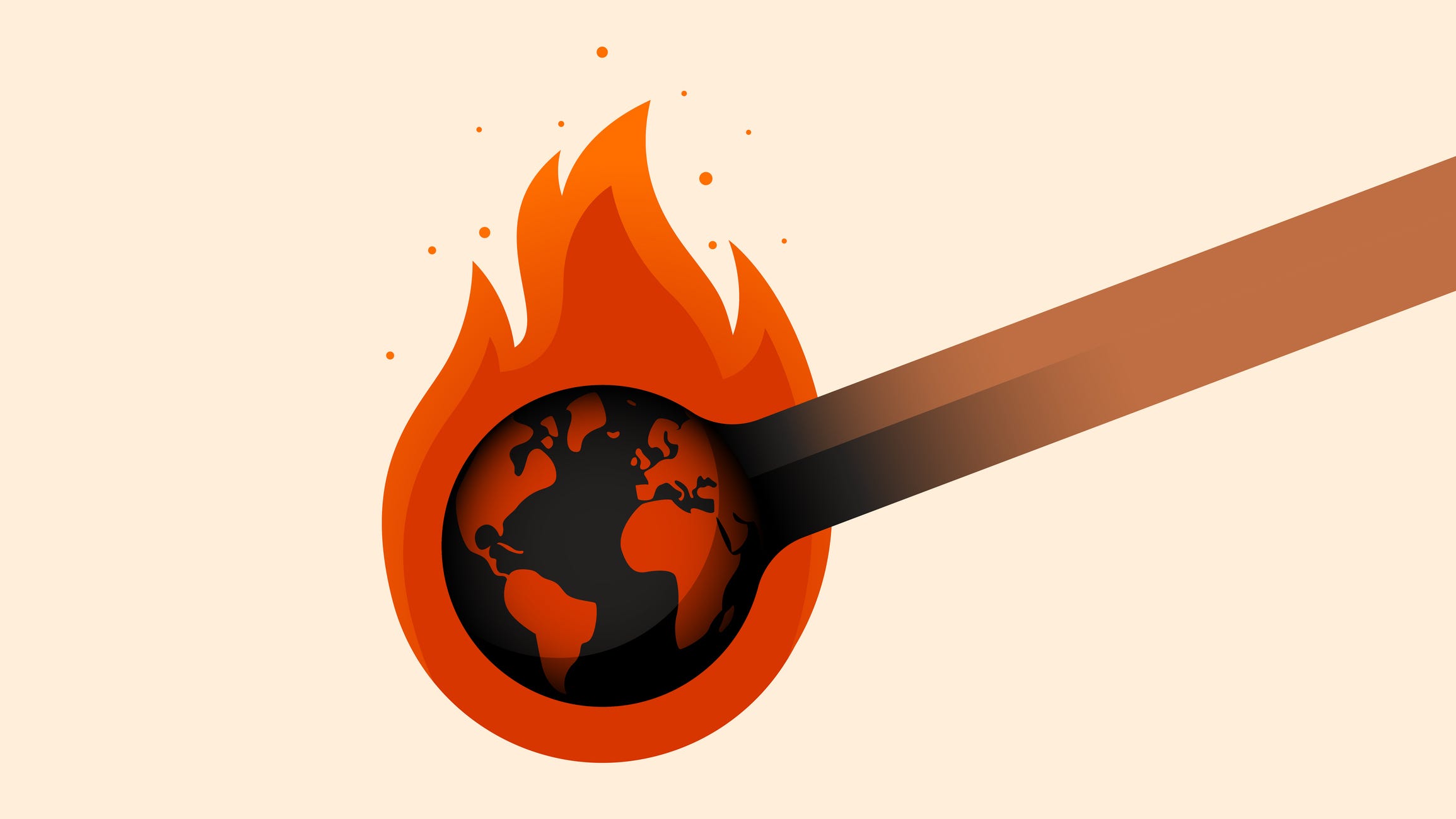
Sweltering heat has been scorching nearly three-quarters of the U.S. population in recent days and weeks, exacerbating deadly floods in Texas and North Carolina, and trapping more than 30 million of us in triple-digit temperatures under a “heat dome” covering 17 states. “It’s as if we’re being cooked under the lid of a giant pot,” says climate writer Jeff Goodell. Red and blue states are starting to demand more federal protection.
CHICAGO— What’s cringe-worthy, always, when it gets really hot?
It’s when somebody says it’s so hot, you can fry an egg on the sidewalk.
This past week, that was actually possible.
Pavement buckled in Wisconsin and Illinois. [Chicago’s annual NASCAR race organizers had to re-surface a street segment of the track blistered by heat.] Trains in the Northeast were slowed or stopped to avoid heat-induced “sun kinks” in the rails. ERs filled up fast in Los Angeles, Chicago and New York with patients suffering heat stroke, and TikTok began buzzing again with videos of people in Phoenix, Dana Point, California, Palm Springs, New York and Las Vegas trying, with some success, to fry eggs on sidewalks, patios and in solar-heated pans on urban rooftops. (Paris also got hit with extreme heat).
Tourism also took a hit. The Washington Monument in D.C. and the Centennial Ferris Wheel on Navy Pier in Chicago closed down when the temperatures exceeded 100. And then, in the most freakish event of them all, high heat exacerbated the speed and intensity of the heavy rains that pummeled Texas Hill Country, causing the Guadalupe River, at one point, to rise 26 feet in just 45 minutes—an extreme heat-induced catastrophe which, at latest count, swept more than 104 people to their deaths in the floodwaters spanning six counties.
These kinds of events aren’t outliers, says Ashley Ward, the director of the Heat Policy Innovation Hub at the Nicholas Institute for Energy, Environment & Sustainability at Duke University. “Events like these are signs that a new era of more frequent and intense heat waves have already started to test infrastructure, public health systems and communities.”
Quiet Killers
The challenge heat poses isn’t as flashy as twisters and hurricanes. “Heat doesn’t, by itself, leave behind eye-catching wreckage,” Ward says. Adds climate writer Jeff Goodell, author of the 2023 book, The Heat Will Kill You First: Life and Death on a Scorched Planet: “When I look out my window, extreme heat looks the same as pretty much anything else. It’s invisible. Tornados, on the other hand, have funnel clouds and hurricanes push trees to the ground.”
Trouble is, the impact of extreme heat, created by heat domes, is no less profound—and it’s global. Western Europe just endured two, back-to-back heatwaves packing extreme heat, both linked to heat domes trapping warm air over affected regions, prolonging the stifling weather and worsening pollution and wildfire conditions.
The heat dome millions of Americans have been experiencing also has been expansive, extending above and across much of the United States, with its effects chiefly felt in 17 states.
Why does extreme heat pose the deadliest threat to public health and safety? When air heated by the sun gets pushed vertically into the atmosphere, it can create a heat dome of high pressure that traps the hot air beneath it, as if it’s bounded by a lid. Heat domes can hover over a city, state, region or country for days—or even weeks. Scientists say heat domes are becoming more frequent and intense due to human-caused climate change largely fueled by the burning of fossil fuels.
“Heat can kill you like a bug zapper—really fast. We humans are now hitting the thermal limits for what our bodies can take, and now the bug zapper is coming for us. More people die from the heat than any other weather-related event. It’s an invisible reality of the world in which we now live.” —Jeff Goodell
In America, according to the National Weather Service:
The average number of heat waves the U.S. experiences today has doubled since the 1980s, and the length of the most dangerous heat season has increased from about 40 days to roughly 70.
Last summer (2024) was the hottest summer on record, globally—ever— since countries began documenting their temperatures in the 1880s, and this summer is likely to be hotter still.
In the U.S. annually, extreme heat remains the deadliest form of extreme weather in the U.S., and since 2023, has been contributing to more than 800 deaths annually.
The good news?
Leaders are beginning to act on this—regardless of their politics.
Business and civic leaders—and even some congressional lawmakers on both sides of the aisle—are creating some new rules to help navigate the rise in extreme heat. “These sectors aren’t waiting for political consensus on climate change,” Ward says. “They’re adapting to the effects that are already here.”
Included in their work:
Congress just formed a bipartisan Extreme Heat Caucus to focus on how extreme heat is affecting workers and creating economic challenges for companies and institutions. The Caucus is also looking into how extreme heat may be posing the kind of health and public safety risks that could be partially mitigated by legislation.
Local governments in Miami and Los Angeles have created the new executive position of Chief Heat Officer, to help them discover the impact of extreme heat on residents, businesses and local infrastructure. Jane Gilbert, Miami’s first Chief Heat Officer told us that one of the first things she did when appointed was ask a group of the city’s community organizations to conduct a series of focus groups and surveys of local residents, to discover what concerns them the most about climate change. “It wasn’t sea level rise,” Gilbert said, “and it wasn’t even hurricanes. It was extreme heat, because that’s the reality they are living day in and day out, with utility bills becoming less affordable, their AC systems needing upgrades, their job needs requiring them to spend more time outdoors, and so on. …It helped us to put together a Heat Action Plan to tell us what we need the most to keep Miami residents and organizations safe and thriving.”
The Pentagon is researching how extreme heat is emerging as a threat to troop readiness, the strength and efficiency of military outposts and the security of supply chains critical to defense operations. The First Street Foundation, a nonprofit that provides climate risk data for properties in the United States, is helping the Pentagon to assess the rising heat and climate risk to its facilities and energy consumption.
Business leaders are beginning to address how extreme heat can slow worker productivity, heat-damage electronics, and render pharmaceuticals unusable. Extreme heat also hits rural economies the hardest. Power outages and supply chain disruption that affects inventories can drive up costs for producers and consumers, alike—if, for example, heat spoils food in warehouses and in grocery stores before their expiration dates. Delta Air Lines is developing policies to protect its passengers and ground crews, who are exposed to high temperatures during flights and on the tarmac when working in proximity to jet engines. United Parcel Service, in a new heat-safety agreement with the Teamsters, recently provided cooling hats, towels and water to its delivery workers, and added exhaust fans and heat shields to each of their vehicles. [In Europe, where extreme heat is also challenging the workforce, Italy and France have begun restricting outdoor work on very hot days, following the lead of Spain and Greece.]
Insurance companies are also beginning to rethink how they should respond to the rising frequency of extreme heat waves. One emerging tool is parametric insurance, a kind of policy that is building climate resilience by issuing automatic payouts when specific temperature thresholds are met to help businesses, farms and independent workers absorb shocks and keep operating.
“Extreme heat is not a niche environment issue,” Ward wrote in a recent guest essay for The New York Times. “It determines whether construction crews can safely finish a job, whether school buildings without adequate air-conditioning can stay open and whether crops make it to market or wither in the field.
“If we start getting really serious about heat, we won’t just weather the summer,” Ward says, “we’ll strengthen the systems communities rely on every day and build a more resilient economy for everyone.”
What do you think? Let us know your thoughts. As always, we thank you for your readership and value your input!
NOTE: This story was updated on July 10th to include additional data on the recent impact of extreme heat domes on Americans and Europeans during the same period.